Tuesday, December 6, 2011

Navigating Laguna Loop: Pila

Pila is one of the towns near in the Laguna de Bay. It is surrounded by the towns of Victoria in the west, Santa Cruz in the east and Nagcarlan in the south. The town is popular because of its heritage houses preserved from the Spanish period as well with the Saint Anthony de Padua Church, the first Antonine church in the country.


Pila and other towns in Laguna de Bay is one of the oldest settlements in the Philippines according to archaeologists where they retrieved potteries and artifacts from the Tang Dynasty. Then in 1578, Spaniards evangelized the town of Pila by the Franciscan friars. They named the town with an exceptional title of La Noble Villa de Pila because of nobility and mildness of characters among the inhabitants. During the time, the demesne of Pila includes Victoria, Laguna and Jala-jala, Rizal. In addition, Don Felizardo Rivera who donated lands in the town was considered the founder of Pila where he is the ancestor of families in the town such as Alava, Rivera, Relova and Agra.

I went there as a part of my travel in the Laguna Loop. From Victoria, you will pass the arch welcoming you to Pila followed by different houses and establishments, rice fields and lush trees as you go along the way to the town proper. Then you will see the junction where you can go to the town proper.
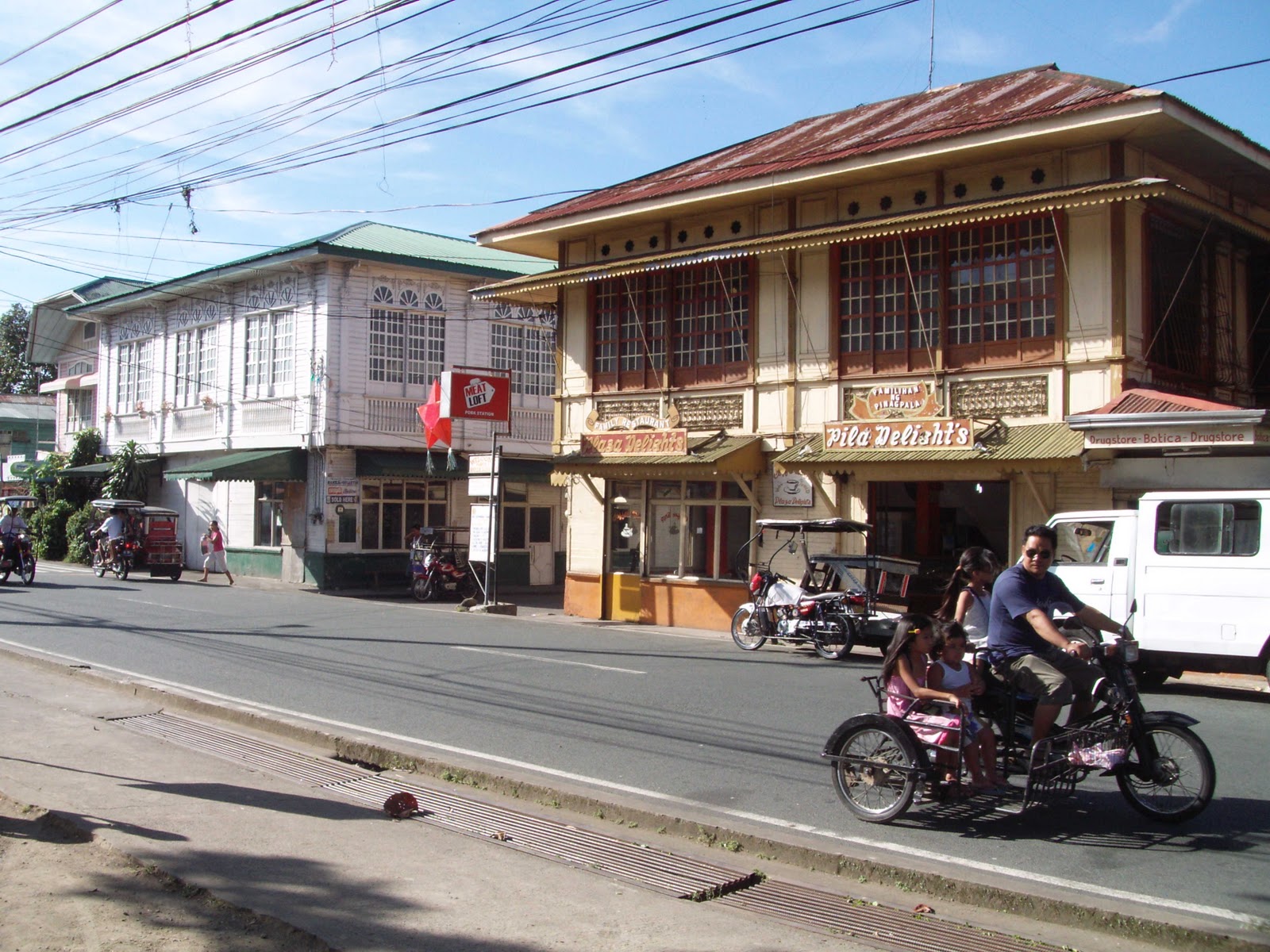
The old houses along with the urbanization and progress in the town of Pila.
Pila Municipal Hall
Pila Church and a basketball court in Pila Heritage Town.

The school beside the church, Liceo de Pila
Pila Museum


The heritage houses along with the urbanization in the town of Pila
A popular convenience store in the town, Pila Delights.

Plaza Delights is a popular restaurant and coffee shop in Pila.

When I was in the Pila Heritage Town, the place truly reminds me of the society during the Spanish period. The church and the town hall are near with each other which shows the unity of Church and State during the Spanish era in the Philippines. Then, the heritage houses dating back from the Spanish era where those families lived in these houses near in the plaza are members of the elite society. There are also places there which you can visit such as the Pila Museum where you can see the memorabilla of different things from the town and we also have a convenience store called Pila Delights where you can buy your stuff at affordable price. Beside the store, there is also Plaza Delights where you can enjoy your coffee break and eat your favorite delicacy. Aside from old houses, Pila is known for its industry of fishing and farming.


Today, although Pila goes with the progress in the modern period, the heritage town is still preserved in order for us to have a glimpse from the past as well with the urbanized but clean ambiance of the town of Pila.
Pila Municipal Hall
Pila Church
Today, Pila goes in the flow of urbanization. However, the old houses and buildings as well with the cleanliness of the plaza remain, that is why the town is peculiar in some ways. 

Sunday, December 4, 2011

Navigating Laguna Loop: Nagcarlan

As we continue our journey in the Laguna Loop, there is a town where you can appreciate the history as well with the fact that you can enjoy the gifts of nature. You can found it in the highland town of Nagcarlan.

Nagcarlan is a town in Laguna surrounded by the towns of Rizal on the southwest, Liliw on the southeast, Calauan on the west, Victoria on northwest, Magdalena on the east and Pila on the north.

Nagcarlan became a town in 1583 under Fr. Tomas  de Miranda, the person who brought the wheat seeds in our country. The town was named after Ana Kalang, a famous rich and generous woman who helped the people of the town. Today, the statue of Ana Kalang can be found under the arch. A few steps away from the statue, you can found the famous landmark in Nagcarlan which is the Underground Cemetery.
The statue of Ana Kalang, a rich and generous woman in Nagcarlan.
The Nagcarlan Underground Cemetery was founded in 1851 by a Franciscan priest named Fr. Vicente Velloc. It was the secret meeting place of the Katipuneros during the Philippine Revolution. Today, it is a historical site where it is one of the most visited tourist attractions in Laguna. It is also first in our country to have an Underground Cemetery. As you enter the place, you will saw a bricked facade of the gate as well with the aisle going to the cemetery. There are almost hundred of niches in the octagonal grounds. Then, you can visit the chapel and the underground crypt where you there are thirty-six niches. Spanish friars, former cabeza de barangays and prominent people in Nagcarlan during the Spanish period was buried in the underground cemetery. 
The bricked facade of Nagcarlan Underground Cemetery.
The way to Underground Cemetery with the octagonal ground with approximately hundred niches. As you walk to the Underground Cemetery, you can see the santan flowers and the green grass in the grounds.

Nagcarlan Underground Cemetery was declared as historical site in 1981.
Then I visited the Nagcarlan Church. It was established in 1752. The Baroque architecture is still evident. There are also beliefs that there is a tunnel that connected from the Church to the  Underground Cemetery. In addition, there are people said that when you climbed the bell tower, you can see the panoramic view of Nagcarlan as well with the neighboring towns Mount Banahaw.
The Nagcarlan Church is one of the churches from the Spanish period.
Nagcarlan is a perfect place for nature getaway for some reasons. First, you can feel the thrill of the zigzag roads as you go to different barangays. In addition, you can also try to do hiking because it is landlocked by different mountains such as Banahaw and San Cristobal. You can feel the refreshing coolness of the clear waters flowing from Mt. Banahaw. There are many resorts such as swimming pools, rivers and waterfalls such as the simple and beautiful Bunga Falls. I rode to a tricycle in order to make it to Bunga Falls and it was such a hard trip especially when it can be found in the middle of dense forests and you can go down with a slippery and rocky slope which made me feel exhausted. However, the view of the waterfall captivates me and it worth a lot from a tiring travel.
Bunga Falls in Nagcarlan.

The clear and cool water flowing from Mount Banahaw. Old folks believed that the water from Banahaw heals  sickness.
The highway in Nagcarlan where you can see Mt.Banahaw.
Nagcarlan is a perfect place to have an idyllic nature getaway. You can feel the lush vegetation, fresh air, clear water flowing in the river, the thrilling zigzag road within the mountainous terrain and the simple rural life of people living in that area. You can recognize the fact that you can travel back in time in Nagcarlan through the Underground Cemetery and the Nagcarlan Church which preserved from the Spanish period that reflects the colorful history of our country.

Saturday, December 3, 2011

Navigating Laguna Loop: Liliw

Tsinelas is a Tagalog term for sandals or slippers. In addition, you can use it when you are travelling in different places especially when you are go on a mountain trekking journey. In Laguna, there are many places which situated on the mountains. One of these places is Liliw, the Footwear Capital of Laguna which is one of the top producers of footwear especially sandals or tsinelas.

Liliw is a municipality in Laguna located in the southern part of the province. It is bounded northwest by Santa Cruz, northeast by Magdalena, on the east by Majayjay, on the west by Nagcarlan and Dolores, Quezon on the south. 

Situated at the foot of Mt.Banahaw, Liliw is known for a highland town, cold spring resorts, clear river, lush vegetation, native home sweets and the industry of sandals and shoes that rivals of Marikina City. Founded in 1571, Liliw came from the bird who delighted on a bamboo and sing "Liw liw liw." 

I came in this town twice and it is an ideal place for nature getaway because when you pass the zigzag and paved concrete roads there, the lush vegetation feels an exciting travel as well with ambiance of fresh air, the clear water flowing in the river, and the verdant trees and plants surrounded in the road. I also passed various resorts such as Batis ng Liliw where you can feel the cool and fresh water from Mt. Banahaw. Right after a fifteen-minute drive in the zigzag roads of Liliw, you can pass the sloping road and visit the busy town proper. It is the business center of the town where you can enjoy shopping various products from sweets to sandals made in Liliw. 


Liliw is known as the top producer of sandals in Laguna that rivals of shoe industry in Marikina. Colorful and fashionable sandals as well with the very good quality in terms of the material used like rubber and wood.
Large sandals can be found in stores and in the tower which signifies the footwear industry in Liliw.
Liliw is known for its industry of footwear. It is considered as one of the top producers of sandals in the Philippines because it is exported to other countries. The footwear of Liliw is not just your ordinary sandals, these footwear are colorful, fashionable and tough because of the raw material used. If Marikina has its large shoes, Liliw has its big sandals from the stalls to the huge sandal stand in the plaza.
Native sweets and snacks sold in Liliw. It is a perfect pasalubong for your family.
In addition, Liliw is also a home of sweets such as uraro, espasol, puto seko, polvoron, banana chips, otap and many more native delicacies which was considered as an all-time favorite among Filipinos. 
St.John the Baptist Church in Liliw, Laguna, one of the Baroque churches in the Laguna loop preserved from the Spanish era.
Last but not the least, I visited one of the Baroque churches in Laguna which is the St. John the Baptist Church. It was founded on 1605, the church was destroyed by an earthquake in 1880 and partly burned in 1898. Therefore, it was reconstructed and today, it is one of the oldest churches in our country because of it was preserved from the Spanish era as well with the style of architecture and the bricked facade.


Therefore, Liliw is a place where you can enjoy the bounties of nature through the lush vegetation, refreshing ambiance from verdant mountains, fresh air and clear water flowing from the river. Liliw is also an ideal venue to experience the Filipino marketplace scene because there are lots of native products to see and buy in this place, from native sweets to footwear, which makes the town one of the top producers of sandals in the country. So now prepare your "tsinelas" to travel on the way to Liliw.
The road from Liliw to Nagcarlan.
© 2011 No copyright infringement intended. All rights reserved.