Friday, December 9, 2011

Navigating Laguna Loop: Paete

In the eastern part of Laguna province, there is a town that lies in the mountains of Sierra Madre  which is known for artistic and ornamented woodcarvings. This is the town of Paete. It is one of the lakeshore towns in Laguna de Bay where it is known as "The Woodcarving Capital of the Philippines" because of the ornamented and well-shaped wood works made from the town. Surrounded by Pakil on the north and Kalayaan on the south, Paete is a town where you can feel the ambiance of verdant mountains through the Sierra Madre, as well with the refreshing view of Laguna de Bay. 

The town named after the Tagalog word "paet" meaning chisel where it is used as a tool for woodcarving. It is also the home of skilled craftsmen who had an expertise in woodcarving and its embellishment. In addition, Paete is also a place where you can appreciate artworks through the town's masterpieces like statues, pulpits, murals, papier maches and bas reliefs. Most of these artworks are used in cathedrals and churches in different parts of the world such as the Saint Peter's Basilica in Rome. The town's hero is a woodcarver named Mariano Madrinan who made the artwork Mater Dolorosa who honored the King of Spain and won a major award in Amsterdam on 1882.  In 2005, President Gloria Macapagal Arroyo declared Paete as "The Woodcarving Capital of the Philippines."

I went to the town of Paete after thirty to forty minutes travel from Santa Cruz City. The first thing I've done is to visit a carpenter shop where the woodworkers made their woodcarvings such as handicrafts, furniture and statues. In addition, I also visited the stores where authentic and embellished woodcarvings and colorful paper maches are sold. In addition, I also entered the art gallery which shows that Paete is not just only focus on sculpture but also in painting.


The ornamented woodcarvings of Paete, Laguna.

The vibrant and colorful papier maches of Paete.
I also visited the Paete Church which considered as one of the Baroque churches in Laguna. The brownish gray color of the church and the Sierra Madre mountain range on the background seems to be captivating. Paete is not just only known for woodcarving industry, farming and fishing are the other sources of living among the people in this town. 
The busy scene in the town proper of Paete.
The view of Laguna de Bay from Paete.
Sierra Madre mountain range reaches from north to south including Laguna.

The Paete Church.
This travel experience in Paete shows that we should appreciate the Filipino talent in visual arts particularly in sculpture, woodcarving and even in painting. The town is a perfect nature getaway as well with the fact that it is the art capital of the province.


The effort of woodcarvers in creating artworks from wood. Courtesy: Cagayat Woodcarving Shop

The town hero of Paete is Mariano Madrinan, who bring honor to our country in 1882 by his work entitled "Mater Dolorosa" which was shown in Amsterdam Exposition.

Tuesday, December 6, 2011

Navigating Laguna Loop: Pila

Pila is one of the towns near in the Laguna de Bay. It is surrounded by the towns of Victoria in the west, Santa Cruz in the east and Nagcarlan in the south. The town is popular because of its heritage houses preserved from the Spanish period as well with the Saint Anthony de Padua Church, the first Antonine church in the country.


Pila and other towns in Laguna de Bay is one of the oldest settlements in the Philippines according to archaeologists where they retrieved potteries and artifacts from the Tang Dynasty. Then in 1578, Spaniards evangelized the town of Pila by the Franciscan friars. They named the town with an exceptional title of La Noble Villa de Pila because of nobility and mildness of characters among the inhabitants. During the time, the demesne of Pila includes Victoria, Laguna and Jala-jala, Rizal. In addition, Don Felizardo Rivera who donated lands in the town was considered the founder of Pila where he is the ancestor of families in the town such as Alava, Rivera, Relova and Agra.

I went there as a part of my travel in the Laguna Loop. From Victoria, you will pass the arch welcoming you to Pila followed by different houses and establishments, rice fields and lush trees as you go along the way to the town proper. Then you will see the junction where you can go to the town proper.
The old houses along with the urbanization and progress in the town of Pila.
Pila Municipal Hall
Pila Church and a basketball court in Pila Heritage Town.

The school beside the church, Liceo de Pila
Pila Museum


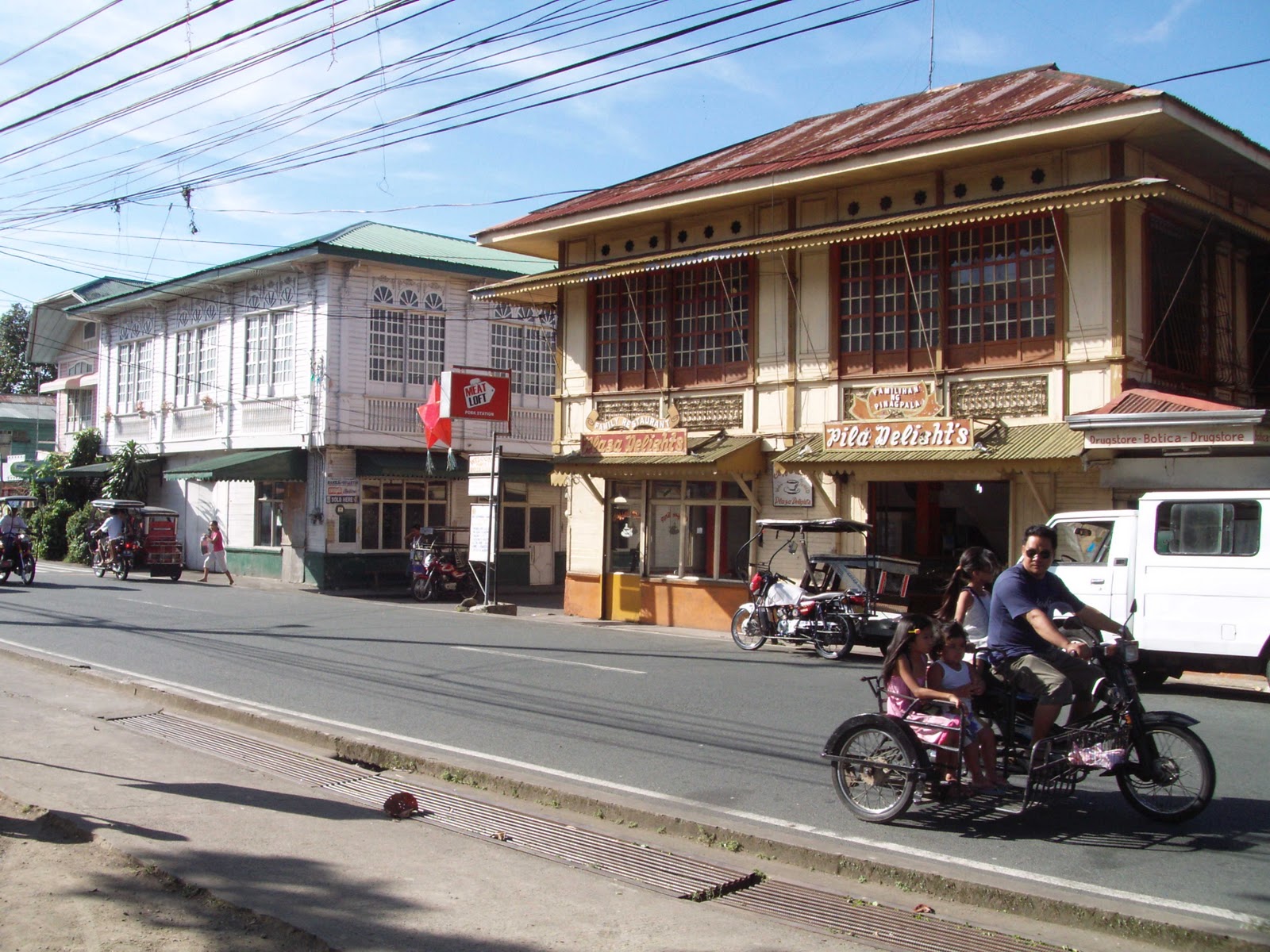
The heritage houses along with the urbanization in the town of Pila
A popular convenience store in the town, Pila Delights.

Plaza Delights is a popular restaurant and coffee shop in Pila.

When I was in the Pila Heritage Town, the place truly reminds me of the society during the Spanish period. The church and the town hall are near with each other which shows the unity of Church and State during the Spanish era in the Philippines. Then, the heritage houses dating back from the Spanish era where those families lived in these houses near in the plaza are members of the elite society. There are also places there which you can visit such as the Pila Museum where you can see the memorabilla of different things from the town and we also have a convenience store called Pila Delights where you can buy your stuff at affordable price. Beside the store, there is also Plaza Delights where you can enjoy your coffee break and eat your favorite delicacy. Aside from old houses, Pila is known for its industry of fishing and farming.


Today, although Pila goes with the progress in the modern period, the heritage town is still preserved in order for us to have a glimpse from the past as well with the urbanized but clean ambiance of the town of Pila.
Pila Municipal Hall
Pila Church
Today, Pila goes in the flow of urbanization. However, the old houses and buildings as well with the cleanliness of the plaza remain, that is why the town is peculiar in some ways. 

Sunday, December 4, 2011

Navigating Laguna Loop: Nagcarlan

As we continue our journey in the Laguna Loop, there is a town where you can appreciate the history as well with the fact that you can enjoy the gifts of nature. You can found it in the highland town of Nagcarlan.

Nagcarlan is a town in Laguna surrounded by the towns of Rizal on the southwest, Liliw on the southeast, Calauan on the west, Victoria on northwest, Magdalena on the east and Pila on the north.

Nagcarlan became a town in 1583 under Fr. Tomas  de Miranda, the person who brought the wheat seeds in our country. The town was named after Ana Kalang, a famous rich and generous woman who helped the people of the town. Today, the statue of Ana Kalang can be found under the arch. A few steps away from the statue, you can found the famous landmark in Nagcarlan which is the Underground Cemetery.
The statue of Ana Kalang, a rich and generous woman in Nagcarlan.
The Nagcarlan Underground Cemetery was founded in 1851 by a Franciscan priest named Fr. Vicente Velloc. It was the secret meeting place of the Katipuneros during the Philippine Revolution. Today, it is a historical site where it is one of the most visited tourist attractions in Laguna. It is also first in our country to have an Underground Cemetery. As you enter the place, you will saw a bricked facade of the gate as well with the aisle going to the cemetery. There are almost hundred of niches in the octagonal grounds. Then, you can visit the chapel and the underground crypt where you there are thirty-six niches. Spanish friars, former cabeza de barangays and prominent people in Nagcarlan during the Spanish period was buried in the underground cemetery. 
The bricked facade of Nagcarlan Underground Cemetery.
The way to Underground Cemetery with the octagonal ground with approximately hundred niches. As you walk to the Underground Cemetery, you can see the santan flowers and the green grass in the grounds.

Nagcarlan Underground Cemetery was declared as historical site in 1981.
Then I visited the Nagcarlan Church. It was established in 1752. The Baroque architecture is still evident. There are also beliefs that there is a tunnel that connected from the Church to the  Underground Cemetery. In addition, there are people said that when you climbed the bell tower, you can see the panoramic view of Nagcarlan as well with the neighboring towns Mount Banahaw.
The Nagcarlan Church is one of the churches from the Spanish period.
Nagcarlan is a perfect place for nature getaway for some reasons. First, you can feel the thrill of the zigzag roads as you go to different barangays. In addition, you can also try to do hiking because it is landlocked by different mountains such as Banahaw and San Cristobal. You can feel the refreshing coolness of the clear waters flowing from Mt. Banahaw. There are many resorts such as swimming pools, rivers and waterfalls such as the simple and beautiful Bunga Falls. I rode to a tricycle in order to make it to Bunga Falls and it was such a hard trip especially when it can be found in the middle of dense forests and you can go down with a slippery and rocky slope which made me feel exhausted. However, the view of the waterfall captivates me and it worth a lot from a tiring travel.
Bunga Falls in Nagcarlan.

The clear and cool water flowing from Mount Banahaw. Old folks believed that the water from Banahaw heals  sickness.
The highway in Nagcarlan where you can see Mt.Banahaw.
Nagcarlan is a perfect place to have an idyllic nature getaway. You can feel the lush vegetation, fresh air, clear water flowing in the river, the thrilling zigzag road within the mountainous terrain and the simple rural life of people living in that area. You can recognize the fact that you can travel back in time in Nagcarlan through the Underground Cemetery and the Nagcarlan Church which preserved from the Spanish period that reflects the colorful history of our country.
© 2011 No copyright infringement intended. All rights reserved.