|
| The welcome arch of Magdalena, Laguna. |
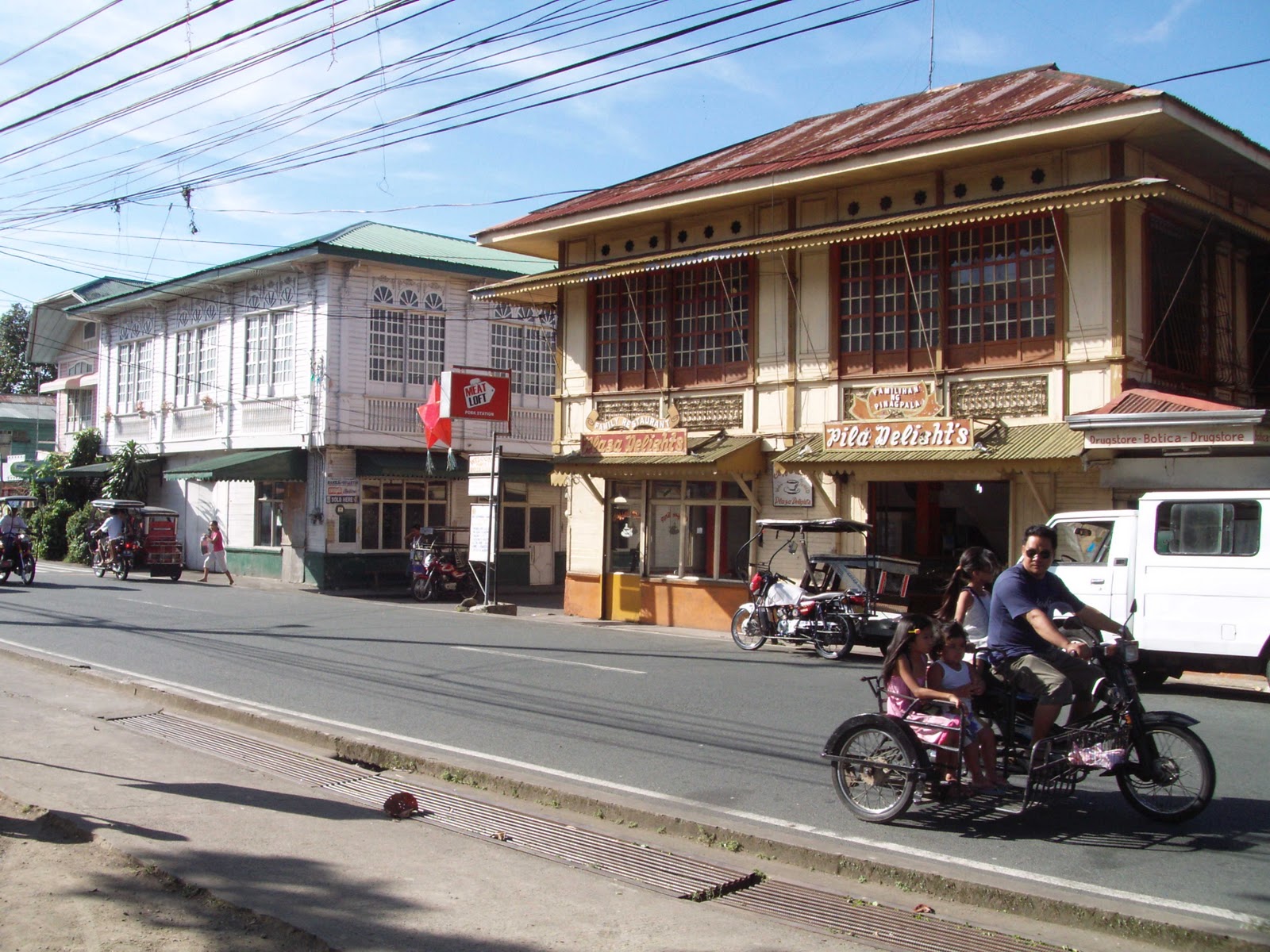
Magdalena is a town where the people are living on a typical provincial life. You can feel the rural ambiance through the coconut plantations, rice fields, clear rivers, lush vegetation and the traditional simple life among the people living in this town.
I went there to experience the peaceful life and it is part of my journey in the Laguna Loop. First, I visited the Bahay Laguna. This landmark was established 14 years ago and it serves as a museum dedicated to Former Governor Felicisimo San Luis, who lead the province for almost 33 years. I had a chance to visit the house and it was surprising that Mrs. Felicidad San Luis, the wife of the former governor, was there during that time. She was able to conduct a leadership training in that house, along with the youth leaders from different parts of Laguna. I had a chance to tour around the museum and I saw all the memorabilla of Governor San Luis which reflects the progress in the province of Laguna during his administration for three decades. I also read a poem entitled "Pangarap" (Dreams) written by Gov. San Luis where it can be sung in the tune of Matt Monro's "The Impossible Dream." In the end of the house visit, I gave a souvenir to Mrs. San Luis as a token of appreciation for meeting her. I also visited the house for the second time where we exchange messages through letters as a remembrance.

In front of Bahay Laguna, there is a marker near in Maimpis River where Emilio Jacinto was shot by the Spaniards during the Philippine Revolution on 1898. He was brought to St. Mary Magdalene Church in order to sought refuge. Today, the markers found in front of Bahay Laguna and in St. Mary Magdalene Church are historical spots which shows that the town served an important role in country's history.
Also, the St. Mary Magdalene Church is one of the Spanish Baroque churches around the Laguna Loop. It was started constructing on 1825 and finished on 1851. It is located in the town plaza of Magdalena along with Rizal Park, a central elementary and secondary school, a stage, and the municipal hall. I had a chance to go around in the plaza where children were able to guide me to Emilio Jacinto marker inside the church.


The most important thing I discovered about Magdalena is the simplicity of life. I enjoyed my trip there because of the rustic ambiance of the town in terms of the location where you can feel the cool air, verdant environment, the tranquil mood of the community, and the cleanliness of roads, rivers and farms. In my case, it was also rare to see the old ways of people which shows the typical life in a rural Filipino area that I witnessed in Magdalena. For example, there are men who used horses in transportation, some women made their laundry in the river, and residents enjoying their life in the farm. Finally, there are past events in the town that takes part in our colorful history of our country that reflects in different landmarks in the town. Therefore, Magdalena is a classic example of a place situated in the lush and verdant foothills which shows a peaceful and typical rural life among the residents and a historical glimpse that you can learn from the town's landmarks.
I went there to experience the peaceful life and it is part of my journey in the Laguna Loop. First, I visited the Bahay Laguna. This landmark was established 14 years ago and it serves as a museum dedicated to Former Governor Felicisimo San Luis, who lead the province for almost 33 years. I had a chance to visit the house and it was surprising that Mrs. Felicidad San Luis, the wife of the former governor, was there during that time. She was able to conduct a leadership training in that house, along with the youth leaders from different parts of Laguna. I had a chance to tour around the museum and I saw all the memorabilla of Governor San Luis which reflects the progress in the province of Laguna during his administration for three decades. I also read a poem entitled "Pangarap" (Dreams) written by Gov. San Luis where it can be sung in the tune of Matt Monro's "The Impossible Dream." In the end of the house visit, I gave a souvenir to Mrs. San Luis as a token of appreciation for meeting her. I also visited the house for the second time where we exchange messages through letters as a remembrance.

 |
| The landmark in the foothills of Mt. Banahaw, Bahay Laguna which serves as a museum for memorabilla of things and achievements during the administration of Felicisimo San Luis, the governor who served Laguna for three decades. In addition, it is also a museum of different local objects which can be found in the province. |
 |
| The office of Governor Felicisimo San Luis. |
 |
| The statue of Gov. Felicisimo San Luis and below his figure, the poem he wrote entitled "Pangarap" (A Dream). |
 |
| The poem "Pangarap" can be sung in a tune of Matt Monro's classic "The Impossible Dream." |
 |
| The products from Laguna which can be found inside the museum. |
 |
| The Emilio Jacinto Marker which serves as a place where he was shot near in Maimpis River in 1898. |

 |
| The St. Mary Magdalene Church in Magdalena, Laguna founded in 1851 where Emilio Jacinto sought refuge in this church after he injured because he was shot by the revolutionaries. |


 |
| The Emilio Jacinto Marker inside the church. There is a part where his blood stains was covered by glass and also a pair of bolo and his hat. |
 |
| The municipal hall of Magdalena, Laguna. |
 |
| The town plaza of Magdalena. |
 |
| Children were able to play football as their pastime. |